
Shipping Container Home Plans: What the Internet Gets Wrong (And What Actually Works)
Share
Shipping container homes have been the internet's favorite alternative housing concept for the better part of a decade. The idea is seductive: repurpose a steel box designed to cross oceans, cut in some windows, add insulation, and you've got a home that's modern, sustainable, and cheap. Architectural photography accounts post the beautiful ones. YouTube channels document the builds. Pinterest boards overflow with renders.
The reality is more nuanced — and in some ways more interesting — than the hype suggests. Container homes can be excellent. They can also be expensive, complicated, and disappointing. The difference usually comes down to how well the plan accounts for the genuine constraints of working with this material.
What Shipping Containers Are Actually Good At
Before getting into plan design, it helps to understand what containers genuinely offer and where the limitations are.
Containers are structurally remarkable — but not in the way most people think. The strength of a shipping container lives in its four corner posts and the corrugated steel walls that connect them. The floor and roof carry relatively little structural load. This matters enormously for design: the moment you cut large openings in the walls for windows and doors, you're removing the very elements that give the container its strength, and you need to engineer replacements.
Containers are also very good at being watertight, resistant to pests, and easy to transport to remote sites. A 20-foot standard container has an interior of roughly 148 square feet. A 40-foot high-cube — the most popular choice for residential construction — offers about 300 square feet of interior space at a ceiling height of 9.5 feet. These are usable but constrained dimensions.
What containers are not good at, without significant work, is thermal performance. An uninsulated steel box is one of the least thermally comfortable structures imaginable. Steel conducts heat and cold aggressively, and the thin walls leave almost no room for insulation. Addressing this — properly, not superficially — is where container home costs often surprise people.
The Real Cost Conversation
Container homes are widely marketed as cheap. This is one of the more persistent misconceptions in the alternative housing space, and it deserves direct attention.
The steel box itself — a used 40-foot high-cube container in reasonable condition — typically costs $3,000–$6,000 plus delivery. That part is genuinely affordable. The work required to turn that box into a livable, code-compliant home is where the costs accumulate.
Cutting openings requires structural steel reinforcement around every window and door. Spray foam insulation on the exterior — the most thermally effective approach — adds cost and changes the exterior appearance. Plumbing, electrical, HVAC, and interior finishes cost roughly the same as in any other residential construction. Foundation work is still required.
A well-built container home typically costs between $150 and $300 per square foot to construct — comparable to conventional residential construction, and sometimes more. Where the value proposition improves is in very remote sites (containers are easier and cheaper to deliver than conventional materials), in modular multi-container designs where the factory-built units reduce on-site labor, and in builds where the owner has real construction skills and can contribute significant labor.
The honest framing: container homes are a legitimate and interesting construction method with real advantages in specific contexts. They are not a shortcut to cheap housing.
Design Principles That Work for Container Architecture
Work with the proportions, not against them.
A 40-foot high-cube container is roughly 8 feet wide and 9.5 feet tall on the interior. That width is limiting for some conventional room configurations but works naturally for others: a bedroom with a queen bed and two narrow nightstands, a galley kitchen, a bathroom with fixtures on one wall, a corridor. Plans that accept these proportions and design within them tend to work better than plans that fight them.
Use multiple containers for larger programs.
A single 40-foot container gives you 300 square feet of interior — workable for a studio or guest cabin but not enough for most primary residences. Multi-container plans stack units side by side, end to end, or in L and U configurations to build out larger programs. The connections between containers require careful structural and weatherproofing detail, but the spatial result can be compelling — especially when offsets and cantilevers create sheltered outdoor spaces and visual interest.
Treat the exterior cladding as a design decision.
Exposed corrugated steel reads as industrial and can work beautifully in the right context. It also performs poorly thermally and weathers in ways that require maintenance in humid climates. Many of the best container home designs clad the exterior in wood, fiber cement, or stucco, either fully or partially — using the steel form as a structural substrate and applying the exterior finish as a separate layer. This approach also opens up more design flexibility.
Maximize the ceiling height in high-cubes.
The extra foot of height in a high-cube container (9.5 feet versus 8.5 feet in a standard) is one of the best arguments for paying the premium. In a narrow space, ceiling height is the primary tool for preventing a cramped feeling. High-cube containers used with minimal interior ceiling build-down can feel genuinely spacious despite the narrow plan.
Plan Types Worth Considering
Single Container Studio (300 sq ft)
The simplest and most buildable option. One high-cube container with a linear floor plan — kitchen and bathroom at one end, living and sleeping at the other. Used most effectively as a guest cabin, artist studio, short-term rental, or seasonal retreat. With good detailing and honest finishes, a single container can feel complete rather than compromised.
Two-Container Plans (500–650 sq ft)
Two containers placed side by side with the wall between them opened create a livable 16-foot-wide footprint — enough for a proper one-bedroom home. This configuration doubles the structural work at the connecting wall but delivers a much more conventional living experience. Common layouts include open living/kitchen in one container, bedroom and bath in the second.
Multi-Container Compound (800–1,500+ sq ft)
Four or more containers arranged in creative configurations. These are the designs that photograph well — offset volumes, cantilevered sections, mixed orientations. They're also the most complex to engineer and build. Plan quality matters enormously at this scale; the structural and weatherproofing details at container connections need to be thoroughly resolved in the drawings.
What Your Container Home Plan Needs to Include
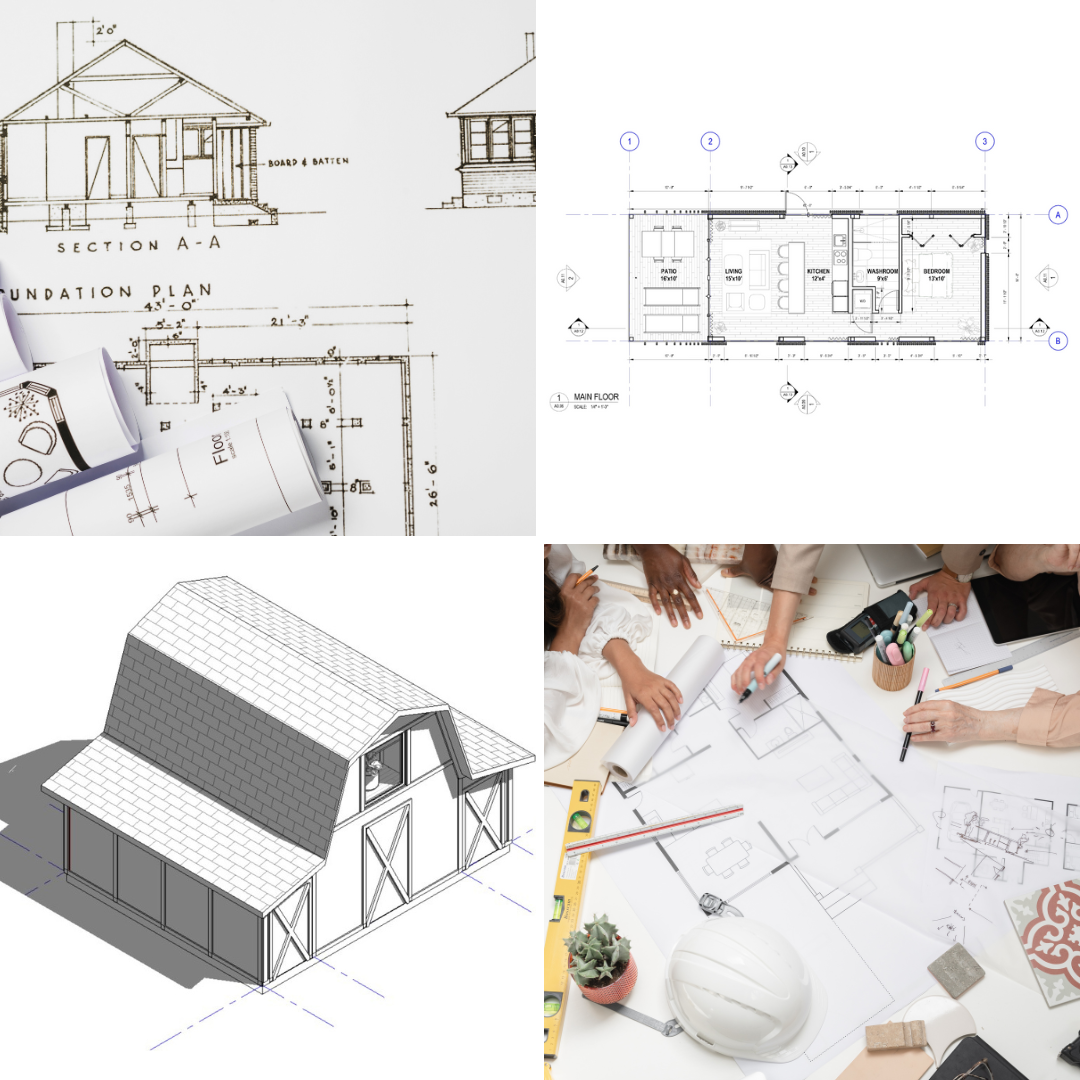
A complete container home plan package should address the specific technical requirements of this construction method in addition to the standard residential drawing set. Look for explicit structural details at wall openings, connection details between containers if applicable, foundation design, and insulation specifications. Vague plans that leave these decisions to the contractor will produce unpredictable bids and potentially expensive surprises.
[Explore our container home plan collection here → https://revitbuildersworkshop.com/]