
How to Read House Plans: A Beginner's Guide to Understanding Blueprints Before You Build
Share
Most people have looked at a house plan and felt a version of the same thing: vaguely confident for about thirty seconds, then quietly uncertain. The lines make sense in a general way. The rooms are labeled. But the abbreviations, the symbols, the multiple sheets with different types of information — it's a lot, and most of us were never taught how to read it.
This matters more than it might seem. Whether you're buying a plan to build from, reviewing drawings a designer has produced for you, or simply trying to evaluate whether a plan suits your needs before purchasing it, the ability to read basic residential drawings gives you real agency in one of the largest decisions most people ever make.
This guide won't make you a building technologist. It will give you a solid working understanding of what's in a residential plan set and how to use that information.
What's Actually in a Residential Drawing Package
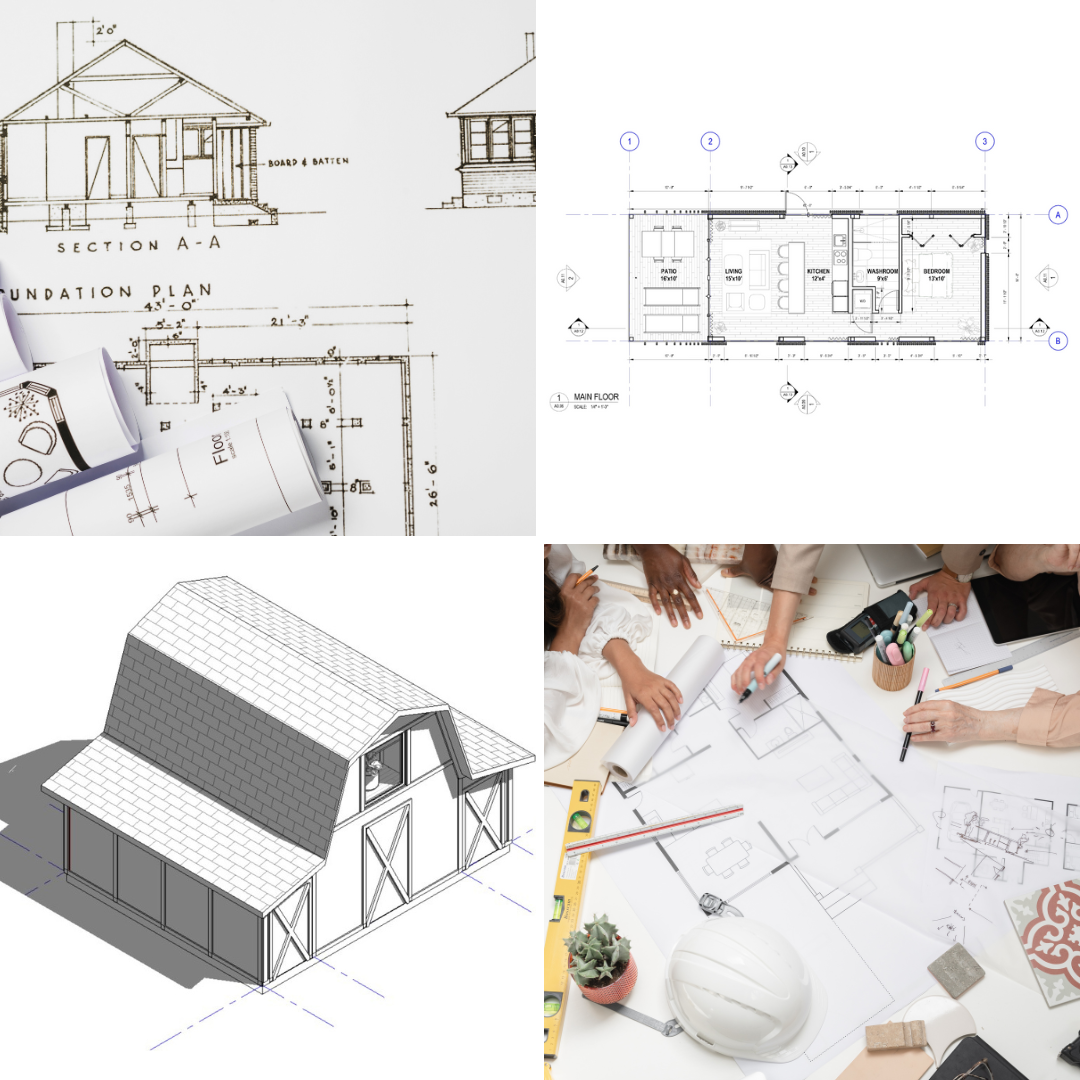
A complete set of residential drawings is not one document — it's a package of related sheets, each showing different information about the same building. Understanding what each sheet type shows is the first step to reading plans confidently.
Floor Plans are the sheets most people think of when they picture house plans. A floor plan is essentially a view of the building from above, as if you'd cut through the walls at about four feet off the floor and removed everything above the cut. You're looking down at the resulting slice. Walls show as thick lines, windows as thin parallel lines interrupting the wall, doors as thin lines with a quarter-circle arc indicating the swing direction.
Floor plans show room layout and dimensions, door and window locations, fixed elements like stairs and kitchen counters, and often furniture layouts (though these are sometimes omitted). The scale note — typically something like 1/4" = 1'0" — tells you the relationship between the drawing and the real building.
Elevations show the exterior faces of the building as if you're standing in front of it at a distance. A complete set has four elevations: front, rear, left side, and right side (sometimes called north, south, east, and west if the designer knows the site orientation). Elevations show the exterior appearance, roof form, window and door heights, and the relationship between the building and the ground.
Sections are cuts through the building in the vertical direction — imagine slicing the building like a loaf of bread and looking at the interior face of the cut. Sections show floor-to-ceiling heights, roof structure, how floors and foundations are constructed, and the relationship between different levels. They're often the most technically informative sheets in the set.
Foundation Plans show the structure below grade (or at grade for slab foundations). They indicate the type of foundation — slab on grade, crawlspace, basement — the dimensions and layout of footings and walls, and any structural reinforcing requirements.
Roof Plans show the building from directly above, indicating the shape of the roof, the direction of slopes (shown with arrows or slope triangles), and roof penetrations like chimneys and vents.
Detail Sheets zoom in on specific construction conditions that require more information than the larger-scale drawings can show — typical wall assemblies, window installations, connection points, and similar specifics.
The Symbols and Abbreviations You'll See Most Often
Architectural drawings use a fairly consistent set of symbols and shorthand across different designers and jurisdictions. Learning the most common ones removes a significant amount of confusion.
On floor plans:
Walls are shown as pairs of parallel lines. Exterior walls are typically drawn thicker than interior walls, reflecting their greater thickness in reality. The space between the lines represents the wall assembly — framing, insulation, and finish layers combined.
Windows interrupt exterior walls with a pattern that usually shows three thin parallel lines — the framing rough opening and the glass. The window schedule (usually a table somewhere in the drawing set) cross-references a number or letter code on the plan to give you the actual window size and type.
Doors show as a single thin line (the door itself) with a quarter-circle arc indicating how far the door swings and in what direction. Pay attention to door swings in small spaces — a door that swings into a bathroom or bedroom in the wrong direction can create real functional problems.
Stairs show as a series of parallel lines (the treads) with an arrow and the word "UP" or "DN" indicating which direction they travel.
Common abbreviations include: W/D (washer/dryer), DW (dishwasher), REF (refrigerator), WH (water heater), CLG HT (ceiling height), FL (floor level), and TYP (typical — meaning this detail applies wherever this condition appears, not just in one location).
On elevations:
Slope triangles indicate roof pitch. A small right triangle with numbers on two sides — like 6:12 — means the roof rises 6 inches for every 12 inches of horizontal run. Steeper roofs have higher first numbers; low-slope roofs have lower ones.
Grade lines show where the ground meets the building. Dashed lines below grade show foundation elements that would otherwise be invisible.
How to Check if a Plan Actually Works for You
Reading a plan isn't just about decoding the symbols — it's about evaluating whether what the designer drew actually works for your needs and your site. Here's a practical approach.
Walk through the plan mentally. Starting at the front door, move through the home the way you actually would. Does the entry sequence make sense? Does the kitchen have a clear path to the dining area? Can you get from the bedroom to the bathroom at 3am without walking through the living room? This mental walk-through reveals functional issues that aren't obvious from studying the drawing statically.
Check the dimensions. The numbers on floor plans are more important than the visual impression of space. A room that looks generous on a small-format print might be 10x10 — adequate but not large. Measure a room in your current home to calibrate your sense of scale, then compare.
Look at traffic patterns. Draw an imaginary line through all the paths people move through the house regularly. Do those paths conflict with the primary use zones — like a traffic path that cuts through the kitchen workspace, or a hallway that passes directly through the living area?
Count the storage. Walk through the plan and mark every storage space: closets, pantries, utility areas, garage storage. Most plans undersell the storage they have; some genuine undersell how little storage they've provided. Look critically.
Check sun orientation if you know it. If you know which direction your lot faces, overlay that on the floor plan. Main living areas facing south capture the most winter sun in the northern hemisphere. Bedrooms facing east get morning light. West-facing rooms get afternoon heat. Whether these are positives or negatives depends on your climate.
When a Plan Needs Adaptation
Even an excellent plan rarely drops perfectly onto any given lot without some adjustment. Common modifications include mirroring the plan (flipping it left-to-right) to better fit a lot or capture views, adjusting window sizes or positions for a specific orientation, modifying the foundation type for site conditions, or updating specifications to meet local code requirements.
These adaptations are normal and expected. What matters is having a complete enough base drawing package that a local designer or drafter can make targeted changes without rebuilding the drawings from scratch.
Explore Plans Designed to Be Built
Understanding how to read house plans gives you the ability to evaluate what you're looking at before committing. The next step is finding plans worth evaluating — designs that have been thought through carefully and drawn with enough detail to actually use.
[Browse our full house plan collection here → https://revitbuildersworkshop.com/]